Introduction
Education is the backbone of every society. For centuries, classrooms looked the same: a teacher in front of a board, students listening, writing notes, and giving exams. But in 2025, something very different is happening. A quiet revolution is shaping how children learn, and its name is Artificial Intelligence (AI).
In the past, AI was mostly linked with robots, machines in factories, or science fiction movies. But now, AI has walked into our schools, colleges, and homes. The rise of AI in Education 2025 is not just a small update. It is a complete change in how knowledge is shared, how students learn, and how teachers teach.
This article will explore how AI is transforming education in 2025, the benefits, challenges, real-life examples, and the future that lies ahead.
What Does AI in Education 2025 Mean?
Artificial Intelligence is the ability of machines to think, learn, and make decisions like humans. In education, AI tools are being used to create smart learning systems that adjust to each student’s needs.
For example, if a student is weak in mathematics, AI offers extra exercises. If another student is good at English, AI provides more advanced material. In this way, AI in Education 2025 creates a personal learning path for every child.
A Short Journey: From Blackboards to AI Classrooms
To understand the changes happening in 2025, let’s take a look back:
- 20th century – Classrooms had chalk and blackboards. Teachers explained lessons, and books were the main source of knowledge.
- 2000s – Computers, projectors, and smart boards appeared. Students started using the internet for learning.
- 2010s – Online classes and e-learning platforms grew rapidly.
- 2020 (COVID-19 pandemic) – Millions of students studied from home using online platforms. This made technology an essential part of education.
Now, in 2025, AI is leading the next step. Education is no longer about just reading online notes. It is about learning from a system that understands you, just like a personal tutor.
How AI is Helping Students in 2025
Personalized Learning
Every child learns differently. Traditional classrooms often fail to meet individual needs. With AI in Education 2025, learning is personal. AI tracks a student’s strengths and weaknesses and then creates a lesson plan just for them.
AI Tutors
Students now have access to AI tutors available 24/7. Whether it is midnight or early morning, students can ask questions and get instant answers explained in simple words.
Instant Feedback
Earlier, students had to wait for teachers to check homework. Now, AI checks assignments within seconds and shows corrections immediately. This helps students improve faster.
Breaking Language Barriers
AI translation tools allow students to learn in their own language. A science lesson in English can instantly be translated into Hindi, Spanish, or French. Education is becoming truly global.
How AI is Supporting Teachers in 2025
Reducing Workload
Teachers spend hours checking papers and preparing reports. AI does these repetitive tasks, giving teachers more time to focus on actual teaching.
Smarter Lesson Plans
AI suggests new teaching methods, videos, or activities based on student performance. If many students struggle in history, AI recommends fresh approaches to make it more interesting.
Professional Growth
AI also gives teachers feedback on their teaching style and suggests training. This helps them become better educators.
Benefits of AI in Education 2025
The rise of AI in Education 2025 brings many advantages:
- Equal Opportunities – Students in small towns or villages can now access high-quality learning through AI apps.
- Faster Understanding – Personalized lessons help students learn difficult topics quickly.
- Cheaper Learning – AI-powered education platforms are often more affordable than private coaching.
- Inclusive Education – Students with disabilities use AI tools like speech-to-text or screen readers.
- Global Classrooms – AI connects students across countries, making education universal.
Challenges of AI in Education 2025
But AI is not perfect. It brings some challenges too.
- Digital Divide – Not every student has a fast internet connection or smart devices.
- Over-Dependence – Students may become lazy if they rely only on AI tutors.
- Privacy Risks – AI collects personal data. If this data is misused, it can harm students.
- Lack of Human Touch – AI cannot replace the care, encouragement, and inspiration of real teachers.
AI and Mental Health Support for Students
In 2025, student stress is a big issue. Exams, competition, and career pressure affect young minds. AI is helping here too.
AI chatbots and mental health apps provide emotional support. They check students’ moods and give advice on relaxation, breathing exercises, or time management. Some AI tools even alert parents or teachers if a student shows signs of depression or anxiety.
While AI cannot replace human counselors, it provides quick help to students who may be too shy to speak up.
AI for Special Needs Education
Another amazing use of AI in Education 2025 is in helping students with special needs.
- For children with speech delays, AI converts text into voice.
- For children with hearing loss, AI provides instant subtitles during lessons.
- For children with autism, AI tools create simple, engaging activities that improve focus and social skills.
This makes classrooms more inclusive, where no child feels left behind.
AI and Examination Systems
Exams have always been stressful. AI is changing this too.
- Smart Evaluation – AI checks answer sheets and assignments instantly.
- Online Proctoring – During online exams, AI detects cheating using webcams and microphones.
- Plagiarism Checkers – Essays and projects are scanned by AI to ensure originality.
- Adaptive Exams – In the future, exams may change difficulty levels based on each student’s performance.
This makes the examination process fairer and faster.

Global Impact of AI in Education 2025
AI is also reducing the gap between rich and poor countries.
- In developed countries like the USA and Japan, AI is used for advanced research, coding, and robotics in schools.
- In developing countries like India and Nigeria, AI helps rural students access quality education through low-cost apps and smartphones.
By 2025, AI is bringing global classrooms closer. A student in Africa can attend the same online lecture as a student in Europe.
Challenges for Teachers in Using AI
Even though AI is powerful, not all teachers find it easy.
- Some teachers are not trained in using AI tools.
- Older teachers sometimes resist new technology.
- Schools in rural areas may not have proper internet or devices.
This shows that AI cannot work alone. Teachers need proper training and support to use it effectively.
Ethical Issues in AI Education
With great power comes great responsibility. AI in education has some ethical problems:
- Data Privacy – Student data must be protected from misuse.
- Screen Addiction – Too much use of AI apps can increase screen time, which is unhealthy.
- Bias in AI – Sometimes, AI systems may favor certain groups of students if not programmed fairly.
Governments and schools must create strong rules to use AI responsibly.
Future of Classrooms Beyond 2025
What will classrooms look like in 2030? Experts predict:
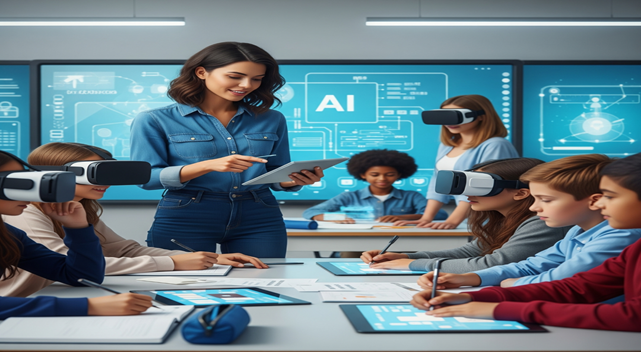
- AI Robots as Assistants – Robots will help teachers explain lessons and manage classrooms.
- Hologram Teachers – Students may attend lessons taught by a 3D hologram of a teacher from another country.
- Virtual Reality (VR) Learning – Students will study history by “visiting” ancient Rome through VR headsets.
- AI Career Guides – AI will suggest future careers to students based on their skills and interests.
The future looks exciting, but balance between technology and human values will remain important.
Real-Life Examples of AI in Education 2025
- Byju’s and Unacademy (India) – Using AI to personalize lessons for millions of students.
- Duolingo – Adapts language lessons to each learner’s speed.
- Google Classroom – Tracks student progress with AI support.
- Khan Academy – Recommends courses using AI analysis.
These examples show that AI is already transforming classrooms worldwide.

Preparing Students for the AI Age
Students of 2025 must prepare for a future where AI is everywhere. They should:
- Learn digital skills like coding and problem-solving.
- Build creative skills like writing, art, and design.
- Develop human qualities like empathy, teamwork, and leadership.
Parents and teachers must guide children to use AI as a tool, not as a replacement for their own thinking.
Frequently Asked Questions
Q1. What is AI in Education 2025?
It means using smart apps, AI tutors, and tools to make learning more personal and effective.
Q2. Will AI replace teachers?
No. AI will only reduce workload. Teachers are still needed for emotional support and guidance.
Q3. How does AI help students?
It provides personalized lessons, instant feedback, and translation in many languages.
Q4. Is AI used in exams?
Yes. AI helps in checking papers, detecting cheating, and creating fair exam systems.
Q5. What are the risks of AI in education?
Over-dependence, privacy concerns, screen addiction, and lack of human connection.
Conclusion
The rise of AI in Education 2025 is one of the biggest changes in human history. For the first time, every child has the chance to learn in a way that suits them best. From AI tutors to inclusive tools for special needs, from rural classrooms to global connections—AI is breaking old barriers and opening new doors.
But AI is not a perfect replacement. Education is not only about knowledge. It is about values, care, and human connection. Teachers will always remain at the heart of learning.
The future of education is not man versus machine. It is man with machine. If used wisely, AI can help create a world where every child learns better, faster, and equally. That is the true promise of AI in Education 2025.
You may also like to Read: https://techno.spherevista.com/digital-marketing-in-patna-business-face/